Materials
MDF vs Plywood Wardrobes: Which Is Better for Chennai Homes?
MDF or plywood for your wardrobe? A structural comparison — strength, moisture resistance, screw holding, lifespan and cost — for Chennai's coastal climate.
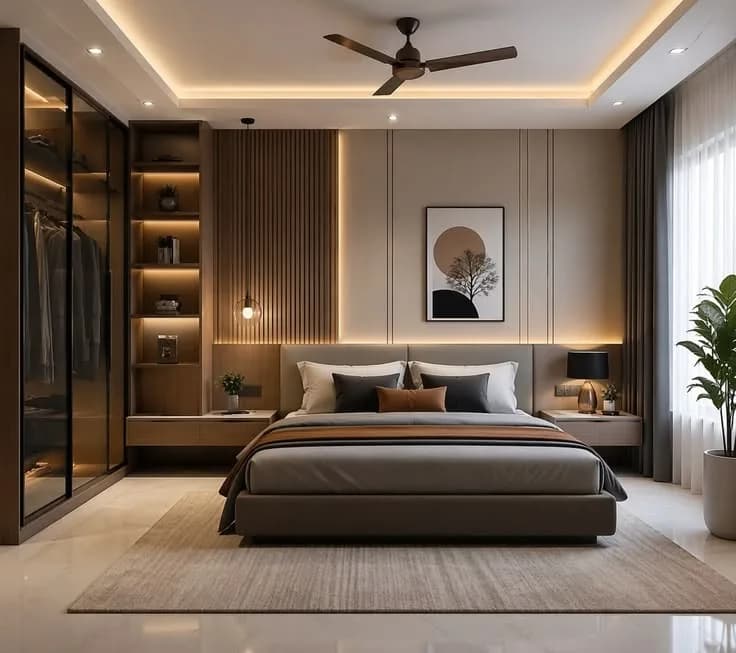
One of the biggest decisions in any home interior is the core material of your cabinetry. Most homeowners end up comparing MDF vs plywood wardrobes — and in Chennai, that decision matters more than almost anywhere else, because coastal humidity punishes the wrong choice quickly.
Understanding the two materials
MDF (Medium Density Fibreboard) is engineered by breaking wood down into fine fibres, combining them with wax and resin, then compressing under heat and pressure. Because it's made of microscopic particles, it has an exceptionally smooth, uniform surface with no knots or grain — which makes it a superb canvas for CNC routing and sleek painted finishes.
Plywood is made by bonding thin layers of natural wood veneer, cross-laminated with each layer rotated 90°. That cross-grain structure is what gives plywood its dimensional stability and load-bearing strength. For wardrobes, we recommend BWR or BWP grades only.
Head-to-head
| Feature | MDF | Plywood (BWR / BWP) | | --- | --- | --- | | Structural strength | Moderate — sags under heavy horizontal loads | Excellent — rigid across long spans | | Moisture resistance | Low — absorbs moisture and swells | High — treated to resist water and steam | | Screw holding | Moderate — fibre core can strip on re-screwing | Strong — cross-layered veneers grip fasteners | | Average lifespan | 8 – 12 years | 15 – 25+ years | | Best finishes | PU paint, duco, membrane | Laminate, veneer, acrylic | | Budget | Economical upfront | Higher initial investment |
Which wins in Chennai's climate?
Chennai is humid for most of the year, and that airborne moisture penetrates wood fibres relentlessly.
The core weakness of MDF: exposed to high humidity, raw MDF behaves like a sponge. It absorbs ambient moisture, leading to edge swelling, laminate bubbling and a drop in screw-holding capacity — which shows up as sagging wardrobe doors and hinges that pull straight out of the panel.
For this reason, plywood is the preferred choice for the wardrobe framework in Chennai. Its cross-grained layup expands and contracts uniformly, resisting warping and sagging even under the weight of heavy clothing and suitcases.
Where MDF genuinely shines
MDF cuts cleanly without splintering, which makes it ideal for the decorative, external elements:
- PU-painted wardrobes — smooth matte or high-gloss seamless finishes look pristine on MDF.
- Intricate CNC routing — fluted panels, curved edges, shaker-style profile doors.
Where plywood belongs
Plywood gives a sturdy, ultra-stable substrate that bonds well with heavy-duty surfaces:
- High-gloss acrylic — the flat, rigid backing needed to prevent a wavy reflection.
- Premium laminates — rich textures like deep walnut or seaside oak.
- Natural veneers — for an authentic timber aesthetic.
The hybrid approach we actually recommend
We don't believe in a one-size-fits-all material rule. For our residential clients we routinely use a hybrid strategy:
- The carcass: 18 mm BWR plywood — a rock-solid, moisture-proof spine that keeps drawers aligned.
- The shutters: high-grade calibrated MDF, when intricate profiles, hidden handle cuts or matte PU paint are wanted.
This pairing keeps the wardrobe looking high-end on the outside while staying indestructible on the inside — and it's how most premium interior firms build.
Cost, honestly
The final wardrobe cost per sq. ft. is determined by carcass material plus the exterior finish and hardware.
- MDF approach: lower upfront cost. Attractive for budget refreshes, rentals or guest bedrooms.
- Plywood approach: higher upfront cost, but far better long-term value — fewer repairs, fewer hinge-tightening visits, fewer panel replacements.
Frequently asked questions
Can I mix MDF and plywood in one wardrobe?
Absolutely — it's standard practice among premium firms. BWR plywood for the internal partitions and carcass gives you humidity defence; MDF for the doors allows seamless decorative detailing and flawless paint.
How do I prevent termites in a Chennai wardrobe?
Ensure your provider uses plywood treated with anti-termite (ATS) chemicals during manufacturing. We source certified borer- and termite-resistant boards as standard.
Does a plywood wardrobe look as neat inside as MDF?
Yes. Modern plywood wardrobes are lined internally with 0.8 mm balancing laminates in off-white, beige or textured finishes — clean, seamless and upscale.
Final thoughts
MDF is highly capable for dry rooms, budget-focused spaces and intricate front shutters. But for wardrobe structures in Chennai homes, plywood remains the right answer. It handles the climate, bears weight without flexing, and protects your investment for decades.
Explore wardrobe designReady to see real numbers for your home?
Get a transparent, itemised estimate and a free HD 3D walkthrough.
Related reading
Materials
Best Plywood for Modular Kitchens in Chennai (2026 Guide)
BWP vs BWR vs MR plywood for a Chennai modular kitchen — which grade goes where, the right thickness, what to inspect before buying, and trusted brands.
2 July 20264 min read
Materials
Humidity-Proof Interiors for Chennai Apartments: A Complete Guide
Chennai's coastal humidity swells wood, peels laminate and rusts hardware. Ten ways to protect your interiors — materials, edge banding and ventilation.
4 July 20264 min read
Wardrobes & Storage
Wardrobe Design Guide: Sliding vs Hinged, Storage & Finishes
Everything that decides a good wardrobe — sliding vs hinged doors, internal organisation, finishes and how Chennai's humidity affects your material choice.
26 June 20263 min read